

Have you ever considered what type of competitor product matching you needed? Probably not – because most businesses, in most industries need just one type – identical product matches. On the other hand, there are cases where identical matches are not applicable, and you might need to go for similar product matching software in order to grasp the competitive landscape and gain insightful market intelligence. Due to the increased market demand for such projects, we have decided to explain the difference between the two.
Product matching comes first in defining your pricing strategy
When defining your pricing strategy, you will have to make one crucial, yet very early decision: will you compare prices of your products to identical competitor prices, or will you go for similar products on competitor sites. This choice, very key of your competitive pricing and monitoring price changes, is anything but easy, and the purpose of this article is to help you make informed decisions before deciding on comparing your prices to competitors’ prices.
Identical product matching
If both you and your competitor deal with products of same brands, purchased from same vendors, it’s most likely that your assortment will have large overlaps. In other words – we can expect that your Product A has an identical match on your competitor’s website.
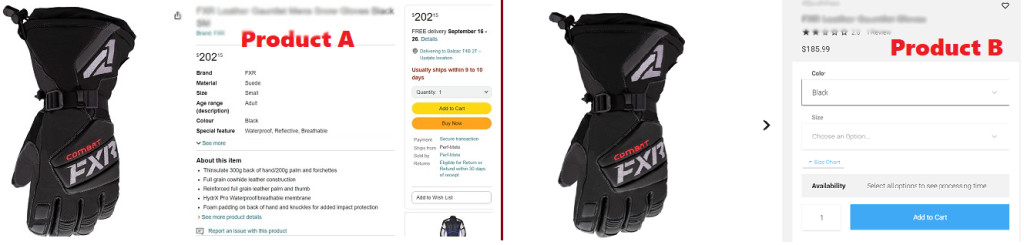
If we analyze two products shown above, by checking available product attributes (including product images), it will be easy enough to spot that they both show the same type of glove, made by the same brand (with price slightly differing).
This is a clear example of identical match, which is applicable to most of our clients, in most industries.
Identical product matching can be performed in all 3 product matching methods
- Fully automated tools, performing product matching process
- Manual matching
- Human curated AI product matching process
What product matching software method will be applied depends on the nature of your products, the size of your project as well as your pricing strategies.
Verifying the matching accuracy is relatively easy, since the product are meant to be identical.
Matching similar products
Lets suppose that you represent a national brand, and that you have products in your listing that no other competitor’s websites can have (because you’re running your own brand (so called private label products)). Or, in case of white-label products, each competitor will have it’s own brand, with products which are very similar. Similar match – this is the scenario that most of product matching solutions struggle with.
Such private label products situations are very common in fashion industry (where two competitors will have very few identically matching products) and also with supermarkets (each carrying food of different brands – which are not identical, but still are comparable.
Clients, when doing the purchase, do not expect to find same products (we may also refer to them as ‘exact matches’ on different websites, but are looking for a product which is ‘similar enough’.

Let’s analyze the example above: Supermarket A sells pineapple juice of Golden Circle brand. Supermarket B does not deal with this brand at all. Instead, they sell pineapple juice of a different brand: P&N
How similar are these pineapple juices? This is not so easy to define, as it depends on available product data, such as
- Volume / packaging
- Product price
- Ingredients
- etc etc – very much dependable on product industry
In this particular case, the similarity has been set to 89%, which was above 80% threshold – which was set by the client as similarity minimum (matches with similarity below 80% are not considered a match).
Similar matches can be a very tricky thing to judge (much more difficult than with identical matches), and our experience says that, although modern machine learning algorithms have made significant progress, we should leave this decision to humans – similarity results obtained from AI (usually depending on natural language processing algorithms) are just too often off and unreliable. In other words, automated product matching, nor human-assisted AI product matching are not a good choice.
This is also why verifying the matching accuracy can be very tricky in case of similarity matching.